Case Study 01 — Product Strategy & Tooling
Capability Experiment Builder
From “We Shipped It” to “We Proved It Matters”
Situation
Product intake was inconsistent, unmeasured, and impossible to defend.
Synchronoss product teams processed feature requests and experiments through an informal intake process. Ideas entered the pipeline at varying levels of definition — some with clear hypotheses and success metrics, most without. Completion rates on structured intake forms sat at 10%. Teams shipped features they couldn’t measure and measured outcomes that didn’t connect to user or business value.
The downstream cost: product reviews became defense sessions rather than decision sessions. Stakeholders couldn’t evaluate competing priorities because the inputs weren’t comparable. Investment rationale was rebuilt from memory in meetings rather than established upfront.
10→60%
Intake completion rate, before vs. after
10-Step
Structured evaluation framework, org-standardized
Org-wide
Adoption across product teams, CTO-endorsed
“The level of rigor illustrated is great and required for product team members processing and creating an intake.”
Before State
Intake Completion
10%
Of structured experiment definitions completed before work began
Outcome Visibility
None
No standardized framework to connect shipped features to measurable business impact
Decision Quality
Tribal
Move / refine / stop decisions made without documented evidence criteria
Stakeholder Confidence
Low
Executives couldn't compare competing initiatives — framing varied team to team
Task
Define a new standard — then build a tool to enforce it.
The goal wasn’t a better form. It was a behavioral shift: from “we shipped it” to “we proved it matters.” That required a framework rigorous enough to surface weak thinking, flexible enough to meet teams at different levels of definition, and opinionated enough to hold the line on what “ready” actually means.
Working with Director of Product Management Rob Weinstein — a fellow advocate for outcome-over-output culture — we created both the framework and the tool that operationalized it. The 10-step Capability Experiment Builder needed to do what the old process couldn’t: make incomplete thinking visible before work begins, not after.
Action
A 10-step process built to make incomplete thinking impossible to hide.
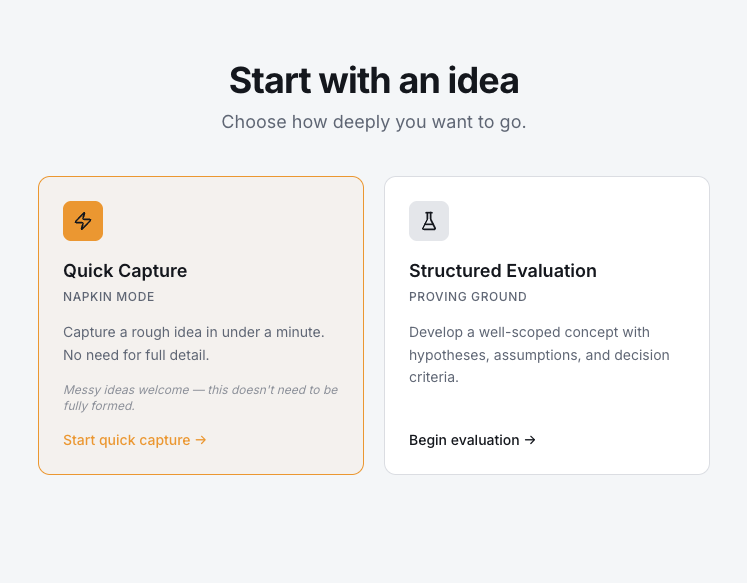
The tool opens with a critical UX decision: two entry modes that serve different stakeholders. Quick Capture (Napkin Mode) meets teams where ideas actually originate — rough, incomplete, worth capturing. Structured Evaluation (Proving Ground) is the full framework, designed for experiments ready to enter the queue. The choice itself forces a judgment call: is this an idea or a proposal?
Screen 01
Screen 02
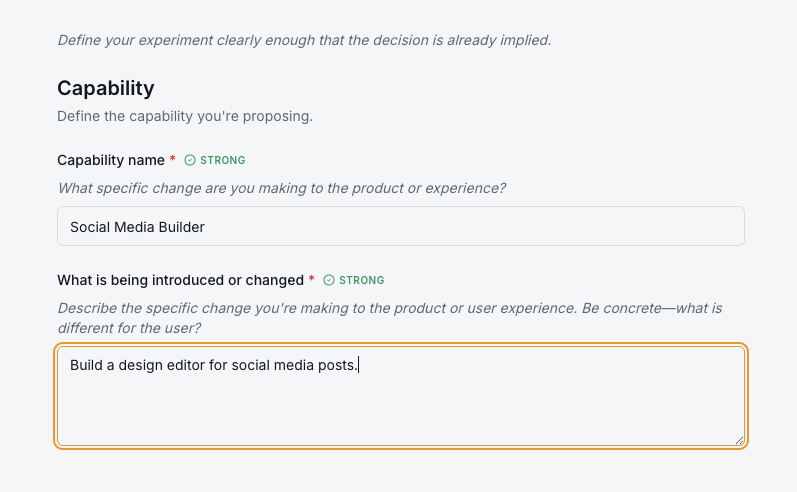
Context & Problem — Before and After — The tool surfaces the gap. “NEEDS SPECIFICITY” flags weak problem statements with targeted coaching — not generic warnings, but prompts that point to exactly what’s missing.
Screens 03 — 04
Screen 05
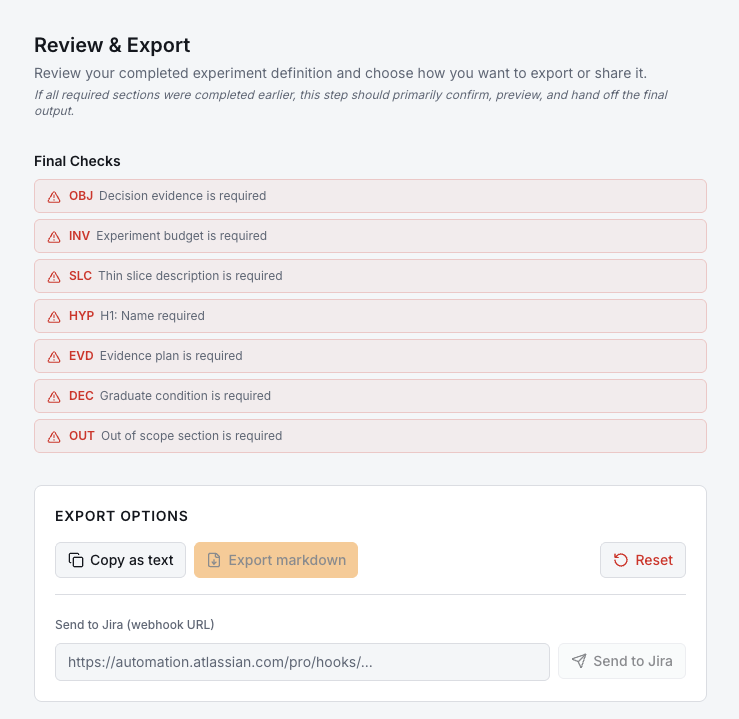
“The tool didn’t just raise the bar. It made the bar visible — for the first time.”
Result
60% completion. A cultural shift that outlasted the initiative.
Structured intake completion moved from 10% to 60%. But the more durable outcome was organizational: the framework became the shared vocabulary for how Synchronoss product teams evaluate, defend, and move on decisions.
The CTO’s endorsement — unsolicited, offered directly after reviewing a team’s use of the tool — confirmed what the completion data suggested: the standard had changed. Not just the process.
The “Shipped it → Proved it matters” ethos co-authored with Rob Weinstein became a standing brief for the SVP of Product (now CTO), and the foundation for a broader org-wide cultural push toward outcome accountability.
60%
Intake Completion Rate
Up from 10% baseline. Structured proposals entering the queue with defined hypotheses, success metrics, and move/refine/stop criteria.
CTO Endorsed
Executive Validation
Unsolicited: 'The level of rigor illustrated is great and required.' Standard elevated org-wide.
Org-wide
Cultural Adoption
Framework became shared vocabulary across product teams. 'Shipped it → Proved it matters' adopted at leadership level.